Pathways to a Carbon-Neutral Structural System
CO₂-induced climate change poses enormous challenges for humanity and is forcing the construction industry—as a major emitter of greenhouse gases—to rethink and adapt its approaches to building design and construction.
In the new issue of nbau (Issue 6/24), Dr.-Ing. Lars Rölle and Dipl.-Ing. Jochen Salmen highlight potential levers in structural design that can be implemented quickly and easily and help significantly reduce the emissions and greenhouse gases caused by the building.
Structural engineers play a pivotal role in this process. This is because the structural system determines up to 50 percent of a building’s carbon footprint.
In addition to the flexibility of the structural system, the materials, building components, and masses used also play a significant role. Reduction and material-appropriate design are effective levers here.
How can the targets applicable from 2040 be achieved as early as possible?
Key levers include:
- Preservation over new construction—by continuing to utilize or revitalize existing built potential.
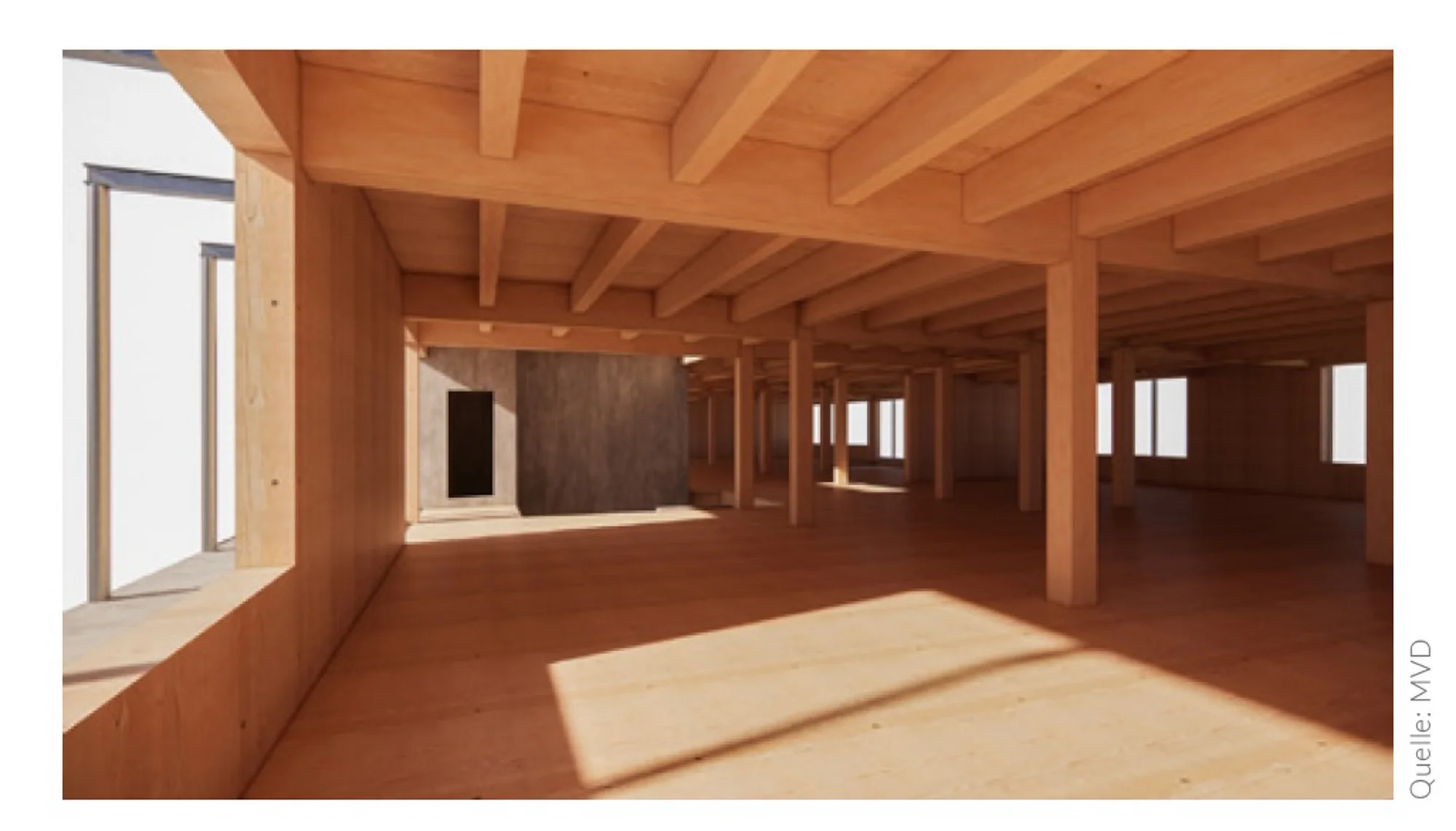
- Building with wood—thanks to CO2 storage, regional wood is suitable for multi-story construction and in structures designed for timber construction.
- Material-appropriate construction—through the targeted use of materials based on their strengths and advantages.
- Optimizing reinforced concrete construction—by minimizing mass through appropriate designs (ribbed slabs, hollow-core slabs, prestressing) and precise calculation of minimum reinforcement. Foundations also offer efficient opportunities.
- Use of greenhouse gas-reducing concrete and steel—here, the use of low-carbon concrete and CO₂-reduced reinforcing steel, produced using renewable energy and 100% scrap content, offers significant savings potential.
- Reuse of materials—through dismantling, recycling, and reuse, structural systems and materials can be flexibly utilized and reused in a circular manner.
Fundamentally, this requires a sensitive and forward-thinking combination of these factors to create a coherent whole. For us in structural engineering, this means adopting different perspectives and optimally balancing the interests of clients and investors, owners and users, as well as society and the environment.
You can find the full article at
https://www.nbau.org/2024/12/13/wege-zum-co₂-neutral-structural-system/